agentlinkops
How to check backlink redirect chains
Trace backlink redirects on the source page and destination separately. Save each observed hop, identify loops and check whether the final page still fits the link.
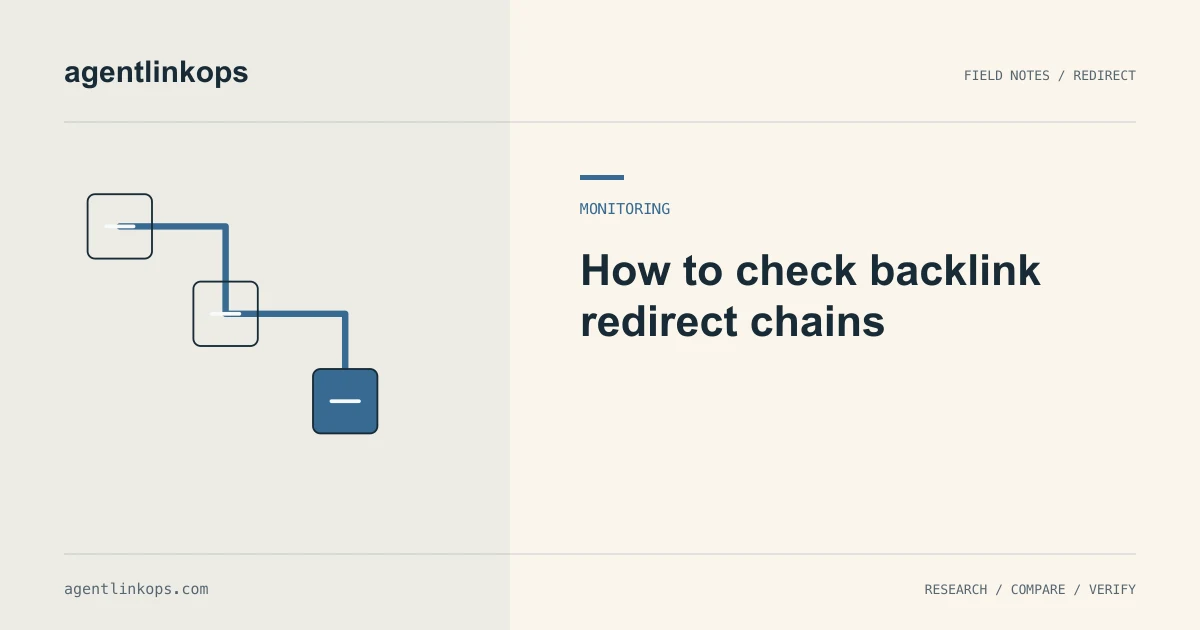
A backlink redirect check has two separate paths: the source page may redirect before you inspect it, and the hyperlink's destination may redirect after a visitor clicks it. Record those paths separately. Otherwise, a moved article and a changed landing page can collapse into the same vague alert.
Start with the backlink monitoring workflow and retain the original source and expected destination. A browser's final address is useful, but it hides the intermediate steps that explain how the reader arrived there.
Trace the source before inspecting the link
Request the stored source URL and record each redirect until you reach a final response or a stopping condition. For each step, keep the address, status and next location. Set a finite limit so a loop cannot run indefinitely.
Once you reach the final source page, inspect its content for the expected hyperlink. If an old article redirects to a homepage, do not assume the placement followed it. The homepage must be checked on its own terms.
Retain the old address in the history even when you choose to monitor the new one. That record explains why a future export and your current monitor use different source URLs. The verification checklist covers the link inspection itself.
Trace the destination as another observation
Copy the destination from the actual hyperlink. Then inspect where that address leads. Store the linked address and the final destination in separate fields.
Google's redirect documentation distinguishes permanent and temporary redirects. Your report should preserve the observed response type without promising how a search system will value the link.
Check the final page's purpose as well as its status. A retired research report redirecting to a product homepage may load successfully while failing the reader's original need. That is a destination-fit issue even if the source hyperlink remains unchanged.
Do not silently replace every old destination with the final address. A link to an old path can still be worth correcting when your team controls that destination or the publisher welcomes updates.
Worked example: two changes in one week
Suppose a synthetic association article moves from /resources/tools/ to /guides/tools/. Its hyperlink still points to your /reports/2024-checklist/, which now redirects to /reports/current-checklist/.
| Path | Observed route | Review question |
|---|---|---|
| Source | Old article to new article | Does the new article retain the link? |
| Destination | Old report to current report | Does the current report answer the cited question? |
If both answers are yes, save the redirects and continue monitoring. If the source lands on an archive page with no hyperlink, investigate the source move. If the destination lands on a sales page, repair or replace your own resource before preparing a publisher request.
These conclusions follow from the synthetic observations. They are not universal rules that all redirects are harmless or harmful. The record should say what changed, who controls the changed page and what review would resolve it.
Identify loops and access limits
A loop may bounce between two addresses or return repeatedly to a previously visited URL. Save the observed steps and stop. A long chain that exceeds your checker limit is also unresolved, even if a different browser eventually reaches a page.
If one step returns an access challenge, record the challenge at that address. Do not report the final destination as absent when you never reached it. Avoid fetching private network addresses or sending account credentials while following an untrusted destination.
Browser-only redirects may need a rendered inspection. State that method in the evidence so the next reviewer does not expect the same chain from an ordinary response request.
Choose the repair that matches the owner
You can usually repair a broken destination on your own site before asking another publisher to edit theirs. Confirm that any replacement preserves the cited resource's purpose. Keep the original resource available when that is the more honest outcome.
For a publisher-controlled source move, prepare a short record of the old URL, final URL and missing or changed hyperlink. Follow the reclamation checklist only after a complete inspection. Add the two redirect paths to your monitoring checklist so later checks compare the same things.
Sources
- Redirects and Google Search · Google Search Central · 2026-04-14