agentlinkops
Backlink discovery vs. monitoring
Compare backlink discovery and monitoring by inputs, evidence, and next actions. Use a worked placement example to separate candidates from links you expect.
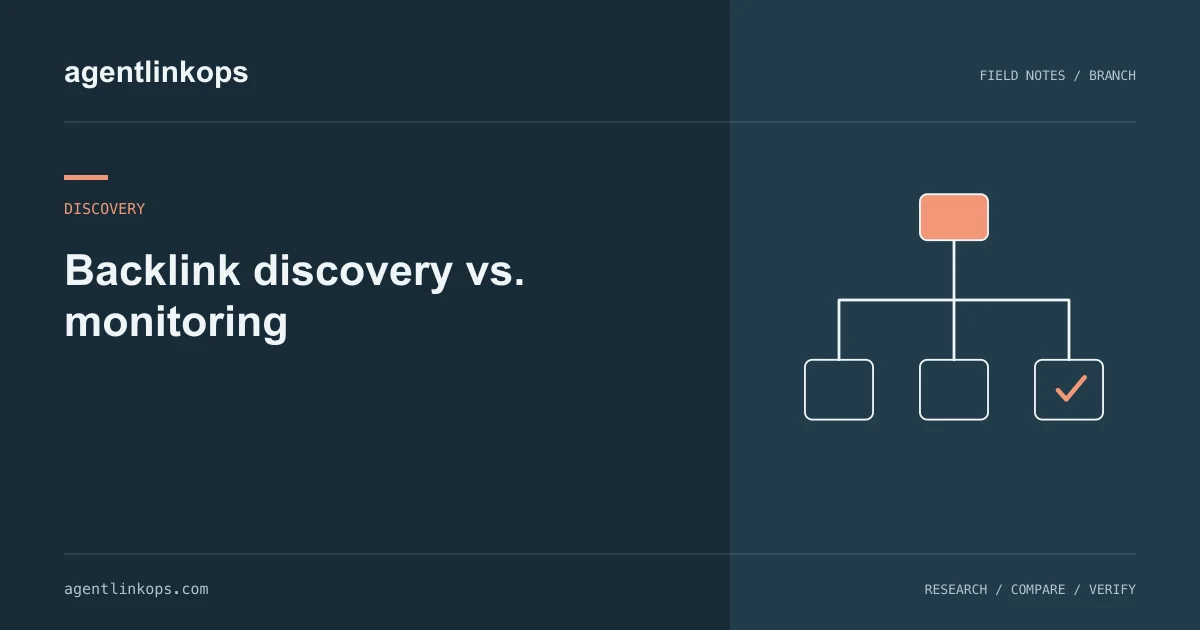
Backlink discovery vs monitoring comes down to the question you are asking. Discovery asks which pages could deserve your attention. Monitoring asks what happened to a link you already expect on a named page. Keeping those questions separate prevents a missing search result from becoming a false lost-link alert.
A candidate can move between the two workflows, but that move needs evidence. Save the source URL, intended destination, observation date, and reason for the transition. The backlink discovery overview explains how research fits into the larger workflow.
Start with different inputs
Discovery can begin with a competitor domain, a list of relevant publishers, a search query, or an imported export. The output is a set of possible source pages. Some may link to a competitor. Others may discuss your subject without linking to any commercial site.
Monitoring begins with an expectation: this source page should contain a link to this destination. You might know that because you saw it, imported an earned-placement record, or received a publisher's confirmation. Record which reason applies. A promise to add a link is weaker evidence than a dated observation of the actual page.
Google's link guidance describes crawlable links using an HTML anchor and an address. That gives an inspection a concrete object to look for. A brand mention, a contact email, and a clickable backlink should occupy different fields in your records.
Follow one candidate through the handoff
This is a synthetic example, not a customer result. A cycling repair business publishes a puncture diagnosis chart. A researcher finds a community workshop's resource page while reviewing local maintenance guides.
On Monday, the workshop page appears in a shortlist. It links to two useful repair references, but the business's chart is absent from the inspected page. The researcher records the page as a candidate and notes the missing diagnostic step that the chart could help readers complete.
On Wednesday, an editor says the chart would fit. The record becomes an agreed placement, with the correspondence kept separately. It still does not become a verified live link.
On Friday, the researcher opens the resource page and finds the chart linked in the tire section. The record now has an observed source URL, target URL, anchor text, and check time. Those fields form the monitoring expectation.
If the Friday check had timed out, the right record would be “check incomplete.” The editor's message could remain attached, but the research team would still need a successful inspection before calling the link present.
Use separate outcomes
| Question | Useful outcome | Evidence needed |
|---|---|---|
| Could this page suit our resource? | Candidate for review | Page context and destination fit |
| Did someone agree to add a link? | Awaiting publication | Dated agreement |
| Can we see the expected link? | Observed present | Successful page inspection |
| Did our request fail? | Inspection incomplete | Error or access result |
These outcomes describe different events. Combining them into one green status hides work that still needs an owner. A candidate can be relevant and inaccessible at the same time. An agreed placement can remain unpublished for weeks.
Read a missing row carefully
A discovery export might omit the workshop page next month. That omission could reflect a changed filter, a different collection date, or a narrower crawl. It supplies no direct observation of the workshop's current HTML.
Before treating the omission as a loss, reopen the expected source page through your normal checking process. Compare the current observation with the earlier one. Keep the discovery export and placement check as separate records so another person can reconstruct the decision.
Our guide to why tools return different results covers comparison problems. The data freshness worksheet explains which timestamps belong beside each result.
Decide who owns the next action
A useful handoff includes an owner and a concrete task. “Review whether the chart helps workshop readers” belongs to research. “Inspect the promised source URL after Friday” belongs to placement follow-up. “Ask the editor about an observed removal” belongs to an approved communication step.
AgentLinkOps keeps research evidence and expected-placement checks distinct. Customer imports exist; live provider discovery remains subject to release and data-access gates. A registered tool alone does not establish that its data lane is available to your account.
Start by finding candidate source pages. Move a candidate into monitoring when you can name the expected relationship and explain why you expect it. That small decision makes later reports much easier to trust.
Sources
- Link best practices for Google · Google Search Central · Not stated; accessed September 12, 2026